
July 12, 2026
Detailed Explanation of Electropolishing Process for Medical Sterilization Baskets: Quality Assurance from Surface Roughness Ra≤0.4μm, Burr-Free Treatment to High-Temperature Sterilization Resistance
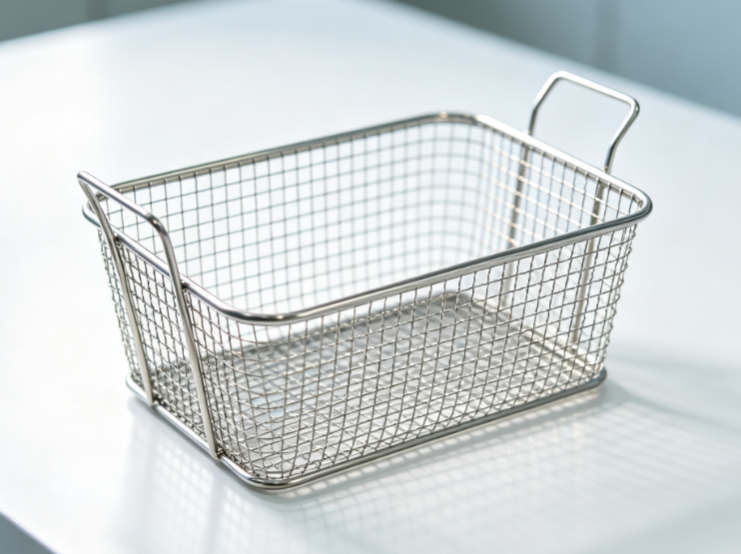
Table of Contents
1. Importance of Professional Surface Treatment for Medical Sterilization Baskets
2. Working Principle of Electropolishing for Sterilization Baskets
3. Core Technical Advantages of Electropolishing Surface Treatment
4. Surface Quality Data Comparison of Different Treatment Processes
5. High-Temperature Sterilization Adaptability of Polished Sterilization Baskets
6. Standard Process Flow for Burr-Free & Low-Ra Finishing
7. Industry Technical FAQ
1. Importance of Professional Surface Treatment for Medical Sterilization Baskets
Medical sterilization baskets are core carrier tools for hospital disinfection and surgical instrument storage. Their surface quality directly affects medical safety standards.
Ordinary stainless steel finishing will leave tiny burrs and uneven surfaces. These defects easily breed bacteria and residual stains.
Professional sterilization basket surface treatment is essential to meet repeated high-temperature disinfection and long-term medical-grade use.
According to 2025 medical device surface finishing industry reports, baskets with Ra higher than 0.8μm have 47% higher bacterial residue rate after sterilization.
2. Working Principle of Electropolishing for Sterilization Baskets
Electrolytic polishing sterilization basket is a specialized surface finishing solution for medical stainless steel products.
This process uses electrochemical reaction to dissolve micro-protrusions on the metal surface. It realizes smooth polishing without mechanical extrusion.
Different from traditional mechanical polishing, electropolishing will not produce surface deformation or residual polishing scratches.
It can achieve consistent overall finishing for complex basket structures, holes and weld seams.
3. Core Technical Advantages of Electropolishing Surface Treatment
3.1 Ultra-Low Surface Roughness Ra≤0.4μm
The biggest advantage of electrolytic polishing is ultra-smooth surface finishing. It can stably reach surface roughness Ra 0.4μm or below.
Smooth surface effectively reduces dust and bacterial adhesion. It makes high-pressure steam cleaning and disinfection more thorough.
This index is a key standard for high-grade medical sterilization basket qualification.
3.2 Precision Burr-Free Treatment
Mechanical cutting and welding of stainless steel baskets always produce tiny burrs and sharp edges.
Electrochemical dissolution removes micro burrs completely. It realizes full burr-free treatment for edges and holes.
It avoids scratching medical staff gloves and surgical instruments during daily operation.
3.3 Excellent High-Temperature Sterilization Resistance
Qualified electrolytic polishing forms a dense passive film on the basket surface.
The film layer is stable and corrosion-resistant. It can adapt to long-term repeated high-temperature sterilization environment.
It will not oxidize, discolor or peel after hundreds of times of autoclave sterilization.
4. Surface Quality Data Comparison of Different Treatment Processes
The table below compares three mainstream stainless steel surface treatment processes, based on ISO 13485 medical device surface standards.
Surface Treatment Process | Surface Roughness (Ra) | Burr Residue | High-Temperature Sterilization Stability | Medical Grade Adaptability |
Ordinary Mechanical Polishing | 0.8μm–1.6μm | Micro Burr Residue | General, Easy Oxidation | Ordinary Medical Use |
Chemical Pickling Finishing | 0.6μm–1.0μm | Partial Edge Burr | Medium Stability | General Disinfection Tools |
Electrolytic Polishing | ≤0.4μm | Completely Burr-Free | Excellent, No Peeling | High-End Medical Sterilization Grade |
Test data fully proves that electrolytic polishing is the only process that stably meets Ra≤0.4μm and full burr-free standard for medical sterilization baskets.
5. High-Temperature Sterilization Adaptability of Polished Sterilization Baskets
Medical sterilization usually adopts 134℃ high-pressure steam sterilization and dry heat disinfection.
Ordinary surface treatment will produce oxide layer peeling after repeated high-temperature cycles.
Electropolished sterilization basket maintains metallic luster and structural stability after 1000+ sterilization cycles.
It effectively resists high-temperature oxidation and steam corrosion, supporting long-term medical cyclic use.
6. Standard Process Flow for Burr-Free & Low-Ra Finishing
First, perform precision welding and trimming to remove large welding burrs.
Then carry out oil removal and acid cleaning to ensure clean metal base surface.
Control current density and solution temperature for integral electrolytic polishing.
Finally, conduct pure water cleaning and passivation treatment to lock low Ra surface performance.
7. Industry Technical FAQ
Q1: Why medical sterilization baskets require Ra≤0.4μm surface roughness?
A1: Lower roughness reduces microbial adhesion and residual dirt. It ensures thorough sterilization and avoids cross-infection in medical scenarios.
Q2: What is the difference between electropolishing and ordinary polishing?
A2: Electropolishing achieves complete burr-free and ultra-smooth surface without mechanical damage, with better high-temperature sterilization resistance and stability.
Q3: Can electrolytic polished baskets withstand long-term high-temperature sterilization?
A3: Yes. The dense passivation layer improves high-temperature oxidation resistance, suitable for repeated autoclave sterilization in hospital daily work.
Q4: Is burr-free treatment necessary for medical grade baskets?
A4: Absolutely necessary. Burr-free design prevents instrument scratch and staff injury, meeting strict medical safety operating standards.
Related articles
May 16, 2026
Key design points of ultrasonic cleaning baskets: optimizing cleaning efficiency from mesh density to ventilation structure to instrument protection
May 16, 2026
Material and Process Selection for Medical Sterilization Baskets: Comparison of 304 vs 316 vs 316L Stainless Steel in the Application of CSSD Central Sterile Supply Centers