
August 11, 2026
Micron-level Precision Stainless Steel Wire Mesh with Strict Quality Control
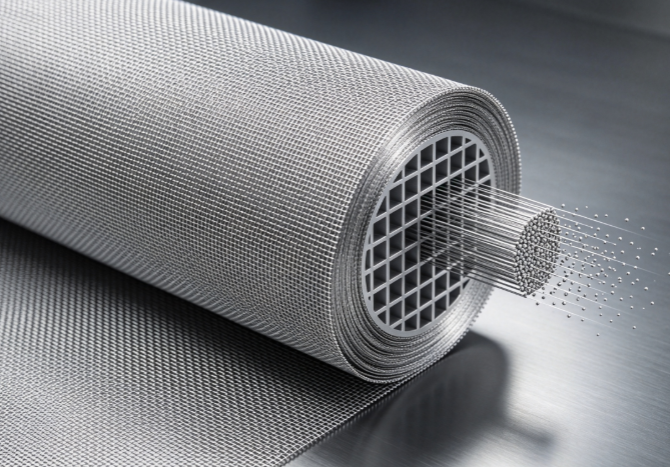
Table of Contents
1. Introduction
2. Material Grades & Weave Types of Micron-level Stainless Steel Wire Mesh
3. Core Technical Standards for Micron Precision Mesh
4. Whole-process Production Control to Achieve Micron Accuracy
5. Typical Mesh Defects & Targeted Improvement Solutions
6. Data Comparison: Conventional Mesh VS Micron-level Precision Mesh
7. Strict Quality Control System Implementation
8. Main Industrial Application Fields
9. Customization Service for Global Industrial Buyers
10. Conclusion
11. Industry FAQ
1. Introduction
Micron-level precision stainless steel wire mesh is an indispensable medium for ultra-fine filtration, particle classification and precise fluid separation. Even tiny aperture deviation at micron scale will cause particle leakage, unstable filtering efficiency and frequent equipment shutdown in precision manufacturing.
Many ordinary woven meshes only meet basic screening demands and cannot sustain consistent micron retention accuracy under continuous working conditions. Our factory focuses on producing micron-level precision stainless steel wire mesh. We adopt closed-loop production management and strict multi-stage inspection to stabilize aperture, wire diameter and flatness within tight micron tolerances. Products comply with ASTM E2016, ASTM E11 and international industrial filtration standards.
This article elaborates precision indicators, key production processes, quality control specifications and application scenarios of micron-grade stainless steel mesh, providing reliable reference for industrial procurement.
Core Industry Keywords: micron-level precision stainless steel wire mesh, ultra-fine filter mesh, stainless steel woven mesh, 304 / 316L wire cloth, micron filtration mesh, precision separation mesh, stainless steel filter mesh manufacturer
2. Material Grades & Weave Types of Micron-level Stainless Steel Wire Mesh
2.1 Common Stainless Steel Materials
· 304 Stainless Steel: Good general corrosion resistance, widely used in food processing, ordinary liquid filtration and air purification.
· 316L Stainless Steel: Contains molybdenum element, outstanding resistance to chloride, saltwater and weak acid medium, preferred for pharmaceutical, chemical and marine working conditions.
· Special Alloy Wire: Available for customized high-temperature and strong corrosive environments upon request.
2.2 Main Weaving Structures for Micron Precision
Plain Woven Mesh Uniform square apertures, stable structure, suitable for medium micron precision filtration and solid-liquid separation.
Dutch Twilled (Dutch Woven) Mesh Compact staggered weaving structure, capable of forming consistent ultra-fine apertures down to several microns. It is the mainstream choice for micron-level precision filtration.
Reverse Dutch Weave High flow rate while maintaining precise particle interception, ideal for high-viscosity fluid filtration.
3. Core Technical Standards for Micron Precision Mesh
3.1 Aperture Micron Tolerance
For micron-grade mesh, average aperture tolerance is controlled within ±3%~±5%. Individual oversized holes are strictly limited to avoid bypass leakage of fine particles.
3.2 Wire Diameter Consistency
Fine wire diameter deviation ≤±4%. Unstable wire thickness will change actual opening size after weaving and deformation under pressure.
3.3 Mesh Count Deviation
Mesh count tolerance ≤±0.5 openings per inch to guarantee uniform distribution of filtering channels.
3.4 Surface Integrity & Flatness
No broken wires, jump wires, wrinkles, local loose weaving. Good flatness reduces stress concentration during forming and service.
3.5 Cleanliness Standard
Oil-free surface is available for food and pharmaceutical grade mesh to avoid medium contamination.
4. Whole-process Production Control to Achieve Micron Accuracy
4.1 Raw Material Incoming Inspection
Each stainless steel wire coil undergoes diameter testing and surface defect scanning. Wires with uneven thickness and surface burrs are rejected.
4.2 Precision Weaving with Constant Tension
Numerically controlled ultra-fine weaving looms maintain stable warp and weft tension throughout long-run production. Fluctuating tension is the primary cause of uneven micron apertures.
4.3 Stress Relief Heat Treatment
Eliminate internal weaving stress, prevent mesh shrinkage and local deformation after cutting and forming.
4.4 Continuous Surface Cleaning
Degreasing, pickling and neutralization remove weaving lubricants and oxidation layers, meeting clean industry requirements.
4.5 Micron-scale Optical Inspection
Automatic optical measuring equipment samples aperture, wire diameter and mesh count for every production roll. Bubble point testing is available for verifying actual filtration precision.
5. Typical Mesh Defects & Targeted Improvement Solutions
5.1 Uneven Micron Apertures
Causes: Unstable loom tension, worn loom components, inconsistent raw wire diameter. Solutions: Regular equipment maintenance; real-time tension feedback control; strict raw material screening.
5.2 Broken Wire & Jump Wire Defects
Causes: Wire surface burrs, improper tension parameters, foreign hard particles entering weaving area. Solutions: Pre-inspect wire surface; optimize tension curve; keep workshop dust controlled.
5.3 Mesh Surface Wrinkling & Poor Flatness
Causes: Insufficient stress relief; uneven winding pressure after weaving. Solutions: Standardized constant-temperature stress relief; unified winding tension control.
5.4 Residual Oil & Surface Oxidation Spots
Causes: Incomplete post-weaving cleaning. Solutions: Multi-stage continuous cleaning line and sealed anti-oxidation packaging.
6. Data Comparison: Conventional Mesh VS Micron-level Precision Mesh
The table below collects practical test data from industrial filtration projects.
表格
Inspection Item | Conventional Stainless Steel Mesh | Micron-level Precision Stainless Steel Mesh | General Industrial Filtration Requirement |
Average aperture tolerance | ±8% ~ ±15% | ≤±5% | Tight tolerance for ultra-fine separation |
Wire diameter deviation | ±6% ~ ±12% | ≤±4% | Stable mechanical performance |
Aperture uniformity rate | 75% ~ 84% | ≥96% | Consistent particle retention |
Occurrence rate of broken/jump wires | 3.1% | 0.35% | Minimize surface defects |
Flatness after cutting | Obvious local warping | Smooth within standard range | Easy for filter element forming |
Batch filtration performance fluctuation | Significant | Very mild | Stable continuous production |
Data clearly shows micron-level precision mesh effectively avoids unstable separation results and frequent filter replacement losses in precision production lines.
7. Strict Quality Control System Implementation
7.1 Raw Material QC
Verify material test report (MTR); inspect wire dimension and surface condition.
7.2 In-process Patrol Inspection
QC staff sample mesh halfway through weaving to monitor aperture and tension status.
7.3 Post-treatment Monitoring
Control heat treatment temperature, holding time and cleaning liquid concentration.
7.4 Finished Batch Inspection
Optical dimension measurement, appearance scanning, flatness test; optional bubble point test for filtration verification.
7.5 Complete Batch Traceability
Unique batch number assigned to each roll; all production and test records archived for export orders.
8. Main Industrial Application Fields
· New Energy Industry: Ultra-fine powder screening for battery raw materials
· Pharmaceutical & Biotechnology: Sterile liquid filtration, raw material impurity removal
· Fine Chemical Industry: Catalyst recovery, precision medium separation
· Food & Beverage: Food-grade liquid clarification, raw material screening
· Water Treatment & Environmental Protection: Precision suspended solid interception
· Aerospace & Electronic Manufacturing: Special fluid filtration, gas purification
· Filter Element Processing: Support layer and functional filter layer for various filter cartridges
9. Customization Service for Global Industrial Buyers
We provide customized width, length, weave type and surface treatment (oil-free cleaning, polishing). Custom micron aperture specifications and special material grades can be developed according to working conditions.
All products can supply material certificates, batch test reports required for overseas tender and customs clearance. We support mass bulk orders and small trial orders for global manufacturers, filter processors and trading companies.
10. Conclusion
For ultra-fine separation and precision filtration, mesh performance depends on micron-scale dimensional stability rather than only visual appearance. Conventional low-precision mesh cannot guarantee consistent particle retention effect, which will bring hidden production risks.
Supported by strict whole-process quality control, micron-level precision stainless steel wire mesh delivers stable filtering accuracy in long-term continuous operation. For buyers engaged in precision chemical, pharmaceutical, new energy and high-end filtration projects, selecting standardized micron-grade mesh suppliers brings long-term stable production benefits.
11. Industry FAQ
Q1: What is the difference between Dutch woven mesh and plain woven mesh for micron filtration? A: Dutch twill weave can achieve smaller uniform apertures for micron-level ultra-fine filtration. Plain woven mesh is suitable for relatively larger micron specifications with higher flow rate.
Q2: Can micron precision be maintained after cutting and forming? A: Mesh with complete stress relief treatment keeps aperture and flatness stable after processing. Mesh without stress relief easily deforms and loses precision.
Q3: What test methods can verify micron filtration performance? A: Optical aperture measurement and bubble point test are common standard methods to confirm actual micron retention capacity.
Q4: How to choose between 304 and 316L micron mesh? A: 316L offers superior anti-corrosion performance against chloride and acid fluid; 304 is cost-effective for atmospheric and fresh water ordinary filtration.
Q5: Can special micron aperture and width be customized? A: Yes. Please provide target aperture size, wire diameter, material grade and weave structure for technical evaluation.
Related articles
May 16, 2026
Key design points of ultrasonic cleaning baskets: optimizing cleaning efficiency from mesh density to ventilation structure to instrument protection
May 16, 2026
Material and Process Selection for Medical Sterilization Baskets: Comparison of 304 vs 316 vs 316L Stainless Steel in the Application of CSSD Central Sterile Supply Centers